
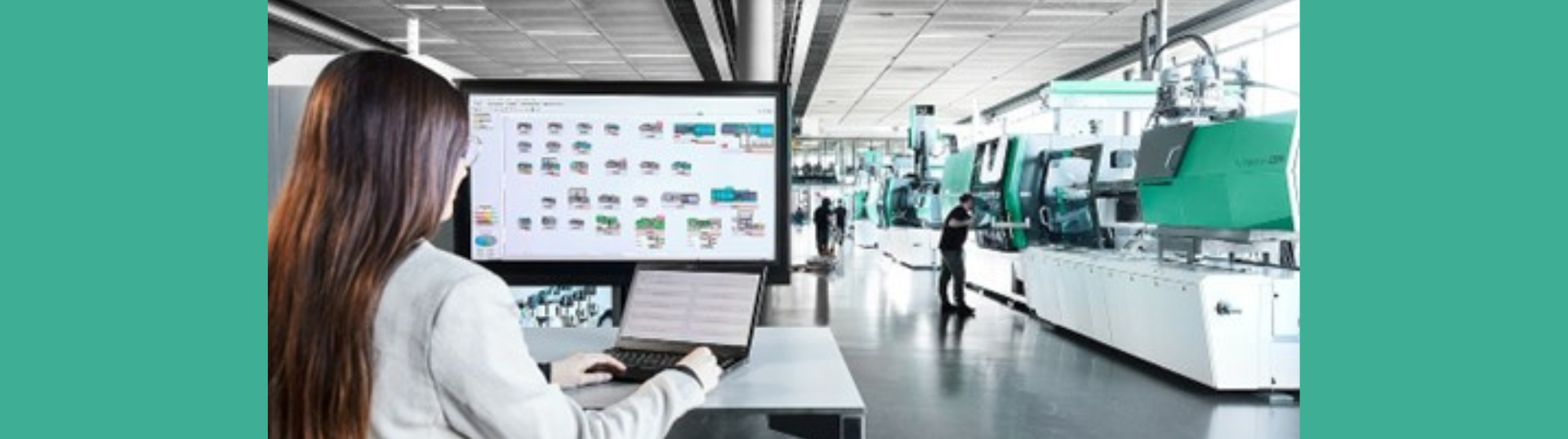
The Connected Workcell: Where Optimization Becomes Sustainable
In plastics manufacturing, optimization is not the problem – isolated optimization is.
Most processors are continuously optimizing: tuning machine parameters, improving automation, refining material handling, or upgrading tooling. These efforts are necessary and valuable. But when optimization happens in silos, gains are often short-lived, difficult to repeat, or hard to scale.
This is where the connected workcell changes the conversation.
A connected workcell doesn’t replace optimization – it makes optimization stick by aligning every element of the process around a shared performance goal. Leading machine builders such as ARBURG have long emphasized this philosophy, designing injection molding platforms that serve as the stable core of a connected manufacturing cell.
Optimization Works Best in a Connected System
A molding operation is already a system, whether it’s treated like one or not. The press, auxiliaries, automation, tooling, and material behavior are constantly interacting. When those interactions are not intentionally aligned, teams often find themselves optimizing one area while unknowingly creating instability in another.
Common symptoms include:
- A well-tuned press producing inconsistent parts
- Automation adjustments that improve cycle time but increase scrap
- Material changes that disrupt otherwise stable processes
- Hot runner performance blamed on the machine — or vice versa
In these cases, each individual component may be optimized, but the system as a whole is not synchronized.
A connected workcell provides the structure that allows optimization efforts to reinforce each other rather than work at cross-purposes.
What Makes a Workcell “Connected”?
Connectivity is less about technology and more about intentional alignment.
A connected workcell is designed and supported so that each component contributes predictably to the overall process.
A Stable Process Foundation
The molding machine provides consistent, repeatable control and serves as the anchor for process optimization. Stable machine behavior enables meaningful improvement everywhere else.
Machine platforms such as those developed by ARBURG illustrate this concept well, combining precise motion control with integrated production management tools that allow processors to stabilize and monitor the entire cell rather than only the press.
Material and Thermal Alignment
Drying, conveying, and temperature control are configured to support the process window – not push it. When material condition and thermal stability are consistent, optimization efforts become repeatable rather than reactive.
Automation That Supports Process Goals
Robotics and automation are optimized not just for speed, but for consistency, part handling quality, and predictable flow. In a connected cell, automation amplifies process stability instead of masking variation.
Balanced Melt Delivery and Tooling Performance
Hot runner and manifold performance are treated as part of the process strategy. Flow balance and thermal control directly support startup consistency, part quality, and scrap reduction.
Shared Visibility and Communication
Operators and technicians can see how the system is performing as a whole. Signals, alarms, and data tell a coherent story rather than competing narratives.
One of the key enablers of this visibility is standardized communication between the molding machine and auxiliary equipment. Modern injection molding platforms increasingly rely on OPC UA interfaces and Euromap communication standards to link dryers, temperature control units, robots, hot runners, and other peripherals into a unified data environment.
Machine platforms such as those from ARBURG allow processors to integrate auxiliary equipment directly into the machine control and production management systems, creating shared visibility across the entire workcell. When equipment communicates through standardized protocols, processors gain consistent access to process data, alarms, and operating states – enabling faster troubleshooting, clearer process insight, and a stronger foundation for future data-driven optimization.
Connected Optimization: Better Results, Faster Learning
When a workcell is connected, optimization becomes more effective — and more efficient.
Instead of repeatedly chasing the problem, teams can:
- Shorten startup and changeover time
- Reduce scrap during transitions
- Maintain consistency across shifts and operators
- Identify root causes with greater confidence
Most importantly, improvements become durable. Changes made in one area don’t unravel performance elsewhere because the system is aligned to support them.
By supporting injection molding machines, auxiliaries, automation, hot runner solutions, and related technologies, we help customers design workcells with optimization in mind from the start, identify integration risks early, align suppliers around common performance objectives, and support lo
ng-term process stability – a systems approach that companies like ARBURG have championed as manufacturing moves toward increasingly connected production environments.
Looking Forward
As manufacturers face increasing pressure from labor constraints, tighter quality requirements, and shorter product lifecycles, the connected workcell becomes a powerful advantage.
Not because it eliminates optimization – but because it allows optimization to work the way it was intended.
The goal is not to choose between connectivity and optimization.
The goal is to connect the workcell so optimization can succeed, scale, and last.