
October 28, 2026
The Importance of Melt Quality: What Happens Before the Plastic Enters the Mold?
In injection molding, considerable attention is given to mold design, processing parameters, and cycle times. Yet one of the most important factors influencing part quality occurs before the material enters the mold: the preparation of the plastic melt.
Inconsistent melt quality can lead to dimensional variations, cosmetic defects, reduced mechanical properties, and unnecessary scrap. Achieving a consistent melt requires attention to several interconnected factors.
What Defines Good Melt Quality?
A high-quality melt is more than material heated to the correct temperature. It requires:- Thermal uniformity: Consistent melt temperature throughout the material.
- Homogeneity: Uniform distribution of additives, colorants, and fillers.
- Complete melting: Proper plasticization without unmelted particles.
- Material integrity: Minimal degradation from excessive heat, shear, moisture, or residence time.
Material Drying: Where Melt Quality Begins
Proper material preparation is essential, particularly for hygroscopic resins such as nylon, PET, and polycarbonate, which absorb moisture. Excessive moisture can cause hydrolytic degradation during melting, potentially reducing mechanical properties and creating cosmetic defects such as splay. Effective drying requires control of temperature, airflow, drying time, and dew point to achieve the manufacturer’s recommended moisture level. Drying technologies from Conair help processors maintain consistent material preparation and establish the foundation for repeatable melt quality. Non-hygroscopic materials such as polypropylene and polyethylene generally do not require drying to remove absorbed moisture, although surface moisture may still need attention.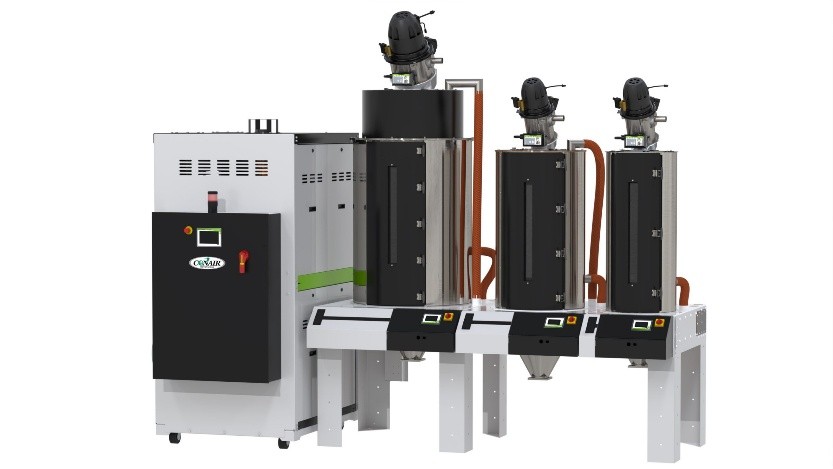
Conair’s modular centralized resin-handling system: ResinWorks™