
Wednesday, February 4, 2026
Premium Use of Space in Plastics Processing: Why Every Square Inch Counts
In plastics processing, space is more than a backdrop – it’s a strategic asset. Whether you’re injection molding medical components, blow molding packaging, or running high-mix automation cells, the physical footprint of your facility directly impacts productivity, cost, and scalability. As margins tighten and demand for flexibility grows, the premium use of space has become a defining competitive advantage.
In modern plastics manufacturing, every square inch counts.
Space as a Cost Driver, Not Just a Constraint
Manufacturing floor space is expensive. Rent or ownership costs, utilities, climate control, material handling paths, and safety clearances all scale with square footage. Yet space is often consumed passively – by oversized equipment, inefficient layouts, or legacy processes that no longer reflect current production needs.
Forward-thinking processors now view space the same way they view cycle time or scrap rate: something to be measured, optimized, and continuously improved.
Smaller Footprints, Bigger Impact
Advances in plastics processing technology are redefining what’s possible within a smaller footprint:
- Compact machine designs allow high clamp forces and precision without sprawling layouts
- Integrated automation reduces the need for separate handling and staging areas
- Multi-functional cells combine molding, inspection, labeling, and packaging in one envelope
By reducing the distance between processes, manufacturers cut material travel, shorten lead times, and improve consistency – all while freeing up valuable floor space.
Vertical Thinking: Using the Third Dimension
One of the most underutilized assets in many plants is vertical space.
Instead of expanding outward, leading facilities are expanding upward:
- Overhead conveyors and part take-off systems
- Vertical drying, blending, and material distribution
- Stacked auxiliary equipment and mezzanine-level storage
Vertical integration not only conserves floor space, it also improves flow and keeps critical pathways clear for people and forklifts.
Layout Optimization Drives Throughput
A premium use of space starts with intentional layout design. High-performing facilities organize equipment around process flow, not convenience or legacy placement.
Key principles include:
- Minimizing part and material travel distance
- Positioning automation and auxiliaries within the machine envelope
- Standardizing cell layouts to simplify expansion and replication
When space is designed around flow, throughput increases without adding machines—or square footage.
Flexibility Is the New Space Efficiency
In today’s market, the most valuable floor space is flexible floor space.
Manufacturers serving medical, packaging, or custom markets must adapt quickly to:
- New tooling
- Changing volumes
- Shorter product life cycles
Modular automation, quick-change tooling, and reconfigurable material handling allow the same square footage to support multiple production scenarios over time. Space that can evolve delivers a far higher return on investment than space locked into a single process.
Digital Planning Prevents Physical Waste
Digital tools now allow processors to simulate layouts, material flow, and automation integration before anything is installed. This reduces costly rework and prevents space inefficiencies from being “designed in” from day one.
A digitally planned factory uses space intentionally – aligning equipment selection, automation strategy, and future growth within the same physical footprint.
The Strategic Advantage of Doing More With Less
In plastics processing, expansion no longer means adding buildings. It means extracting more value from the space you already have.
Facilities that treat square footage as a premium resource benefit from:
- Lower overhead costs per part
- Higher output per machine
- Cleaner, safer, more organized production environments
- Faster response to market changes
In a competitive manufacturing landscape, the plants that win aren’t always the biggest – they’re the smartest with their space.
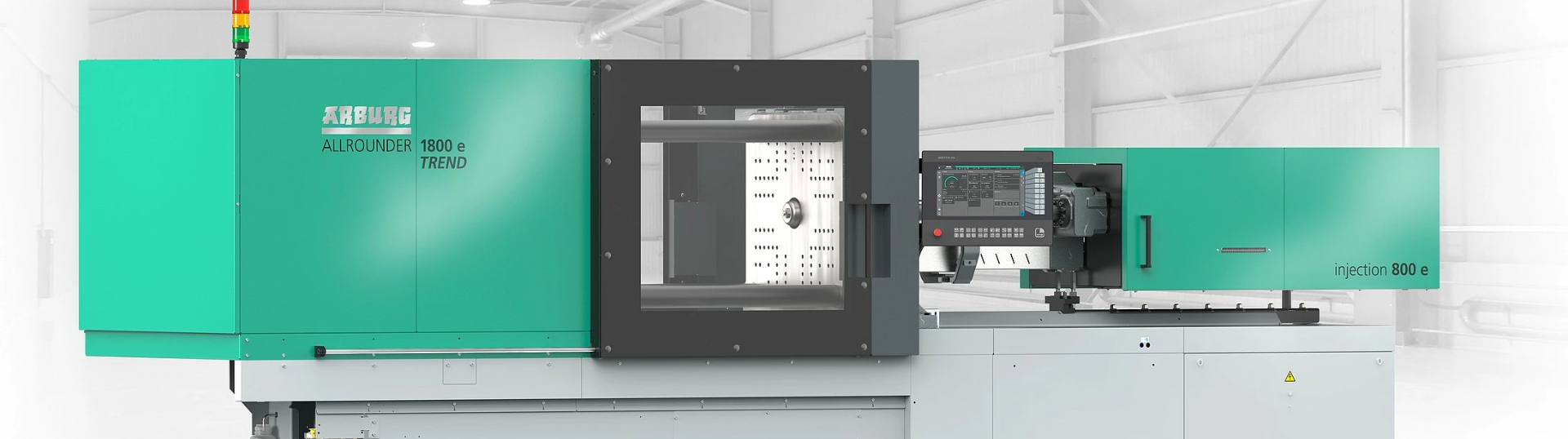
A perfect example of how modern technology maximizes production in a minimal footprint is the new slim electric ALLROUNDER TREND injection molding machine that’s set to make its U.S. debut at MD&M West in Anaheim February 3 – 5 (Booth 4611)
Designed specifically for compact, space-optimized production environments, the Arburg TREND series delivers reliable, high-quality injection molding in a modular electric platform that’s quick to set up, intuitive to operate, and easy to maintain – helping processors do more within less floor space.
When space is treated as a strategic asset, performance follows.
Rethink your floor space, cell design, and machine footprint to unlock more throughput, flexibility, and scalability – because in modern plastics processing, every square inch matters.
Contact us for more information and insights on space-saving solutions.